


Vintage rugs, how to recognise, choose and style them at home
Vintage rugs are loved because they bring something to a room that new pieces lack: softened colours, a lived in surface, the feeling of an object with a story. Yet the same word covers very different things, from a brand new rug with a faded finish to a one of a kind piece woven decades ago. In this guide we look at how to tell them apart, how to recognise an authentic vintage rug, how to style it in a modern home and how to look after it.
Vintage style or authentic vintage, the difference that matters
In the rug trade, vintage conventionally describes pieces roughly 30 to 80 years old: not old enough to count as antique, which usually means more than 80 or 100 years, but old enough to have a patina of their own. There is no official rule, so it is always worth reading the product description carefully.
- Vintage style rugs: these are new, made today, with oriental or classic designs and a worn look created through printing or finishing. They are affordable, come in standard sizes and can be reordered. In our range, the Argentella, Vintage B and Ohio B lines are good examples.
- Authentic or revived vintage rugs: these are genuinely lived in rugs, often hand knotted, with decades of use behind them. Revived pieces are reclaimed and treated, for example by shaving the pile or overdyeing, to give them a contemporary look. Every piece is unique and the price reflects the work involved and its rarity.
Both are perfectly valid: the first is a style choice, the second is also a choice of material and history.
Vintage, revived, antique: how they compare
| Feature | Vintage style (new) | Authentic or revived vintage | Antique |
|---|---|---|---|
| Age | Made today | Roughly 30 to 80 years | Over 80 or 100 years |
| Worn effect | Printed or created in finishing | Real, the result of time and use | Real, with a deep patina |
| One of a kind | No, can be reordered | Yes | Yes |
| Indicative price | From around 20 euros | Varies, often high | High, depending on age, origin and condition |
| Everyday use | Yes, even in busy areas | Yes, with a little care | With caution |
If you also see rugs as something that holds value over time, read our guide to the rug as an investment. Pieces in our authentic antique rugs collection come with a certificate of authenticity.

How to recognise an authentic vintage rug
- Abrash: the variations in tone within a single field of colour, in lighter and darker bands. They come from batches of wool dyed at different times and are typical of artisan dyeing. On a printed rug the colour is even, or the shading repeats in a regular pattern.
- Colours softened by time: reds drift towards brick, blues towards denim, greens towards sage. It is a dusty softness, quite different from the uniform fade of a print.
- The back: on a hand knotted rug you can see the individual knots on the back and read the design almost as clearly as on the front. A fabric or rubber backing points to industrial production.
- Consistent wear: the pile is lower where people have walked most, and the fringes are the continuation of the warp, not a sewn on border.
- Paperwork: always ask for the estimated age, the origin and any restoration or redyeing.
1970s vintage rugs, colours and mood
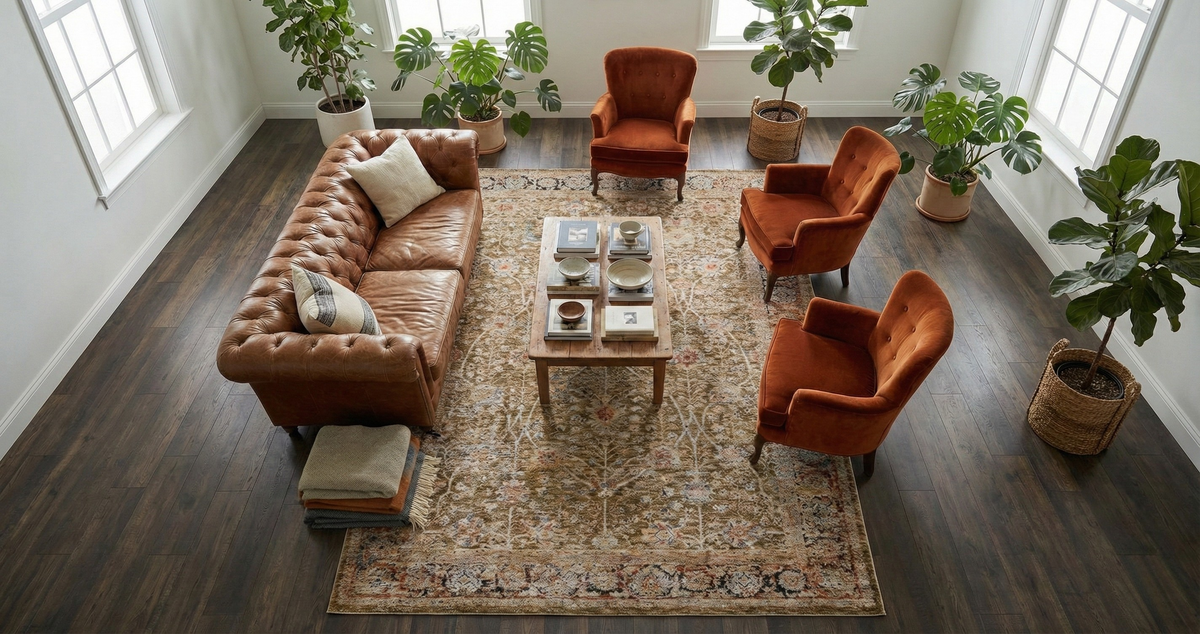
Many people search for a 1970s vintage rug. The phrase means two different things: a rug actually made in that decade, or a new rug that borrows its palette. That palette is easy to spot: burnt orange, mustard, brown and olive green, set against warm woods and leather. A warm toned vintage oriental rug in a living room with a leather sofa and orange armchairs is the clearest example of the mood.
If you want a genuine period piece, check the age and origin in the product description. If the mood is what matters most, a warm coloured vintage style rug achieves the same effect on a modest budget, and you can change it when you change your furniture.
How to style vintage rugs in a modern home
A vintage rug is at its best when it contrasts with something new:
- Minimal furniture and contemporary floors: on concrete, resin or pale porcelain tiles, with clean lined furniture, a vintage oriental rug becomes the focal point of the room.
- Mixed styles: a modern sofa, a 1970s armchair, a simple bookcase. The vintage rug ties together pieces from different eras.
- Bedroom: a pale vintage oriental rug in ivory and dusty pink softens a pastel bedroom.
- Layering: a vintage rug with worn edges, laid on a jute base, comes back to life and gains depth.
- Size: for a living room with a three seater sofa, a 200x300 cm rug lets at least the front legs of the sofa and armchairs sit on it. To choose calmly, see our rug size guide.

You will find more ideas for contemporary interiors in our designer rugs for the living room collection.
How to care for a vintage rug
- Gentle vacuuming: no rotating brush, in the direction of the pile, once a week.
- Stains: blot straight away with a white cloth and cold water, without rubbing.
- Deep cleaning: for an authentic or revived vintage rug, use a specialist rug cleaner; for vintage style rugs, follow the care label.
- Light and rotation: avoid hours of direct sunlight every day, as it speeds up fading, and turn the rug 180 degrees every six months to spread the wear.
Every step is explained in our guide on how to clean oriental rugs.
Vintage rugs at CarpetLiving
Our vintage rugs collection covers both sides of this style, from everyday vintage style rugs to one of a kind pieces. A few examples:
- Vintage B: oriental design in ivory and grey, from around 20 euros.
- Argentella Ming Blue: abstract vintage design in blue, from around 59 euros.
- Ohio B: classic vintage look in grey, from around 26 euros.
- Revive Vintage Special 407x297 cm: a large one of a kind piece, from around 4,920 euros, for anyone looking for a rug with a real story.
Vintage rugs, summary
- Tell vintage style rugs, which are new and can be reordered, apart from authentic or revived vintage rugs, which are one of a kind.
- Vintage usually means 30 to 80 years old, antique more than 80 or 100: it is a convention, so always read the description.
- Abrash, softened colours, knots visible on the back and fringes that continue the warp are the signs of authentic vintage.
- Vintage works by contrast with modern furniture and ties different styles together.
- Gentle care: vacuum without a brush, blot stains, and leave deep cleaning of authentic pieces to specialists.
Share:
Buying a Rug Online, What to Check Before You Order