

Taimany Rugs, History, Features and Why They're Among the Best Sellers
The name "Taimany" appears often in the product descriptions of Afghan rugs, but few know the story behind the term. The Taimany (or Taimuri, Timurid) are one of the oldest historic tribes of western Afghanistan and Khorasan, and their textile production has a tradition dating back centuries. Today, Taimany rugs are among the most appreciated for their wool quality, deep natural colours and tribal patterns with balanced proportions.
Who are the Taimany and where do they live?
The Taimany (or Taimuri) are a tribal ethnic group historically settled in western Afghanistan, particularly in the provinces of Ghor, Herat and Badghis. They are part of the large family of Dari-speaking peoples (Afghan Persian) and have maintained a strong cultural identity through artisan textile production.
For Taimany women, rug-making is a practice handed down from mother to daughter, with patterns memorised and passed on orally before they are ever recorded visually. Every family has its own variants of the traditional patterns — which makes each Taimany rug unique.
The features of the Taimany rug
- Very high-quality wool: the Taimany raise local sheep and use wool from the first shearing (the softest and most resilient). The wool is hand-spun and dyed with natural dyes — pomegranate, indigo, walnut, onion skin — which produce deep colours with nuances that synthetic dyes cannot replicate.
- Tribal geometric patterns: the most typical design is the "gul" — an octagonal or medallion shape repeated in a grid across the field of the rug. The Taimany gul has balanced proportions with fine geometric details in the outlines. The border is usually simple and linear, contrasting with the richness of the field.
- Earthy palette: the dominant colours are wine red (madder), indigo blue, beige/camel and black. The Taimany red has a particular depth thanks to the natural dyes and the distinctive mineral content of the local water used in the dyeing process.
- Turkish (Ghiordes) knotting: most Taimany rugs use the Ghiordes knot, more stable and symmetrical, which contributes to durability over time.
- Variable sizes: they come in large formats (200×300 cm, 250×350 cm), medium (150×200 cm) and runner (80×300 cm). The large formats are the most sought-after.

The difference between Taimany, Kaudani and other Afghan rugs
| Feature | Taimany | Kaudani | Afghan Kilim |
|---|---|---|---|
| Type | Knotted (pile) | Knotted (pile) | Flat (no pile) |
| Pattern | Repeated geometric gul | Grid gul, denser | Geometric, stripes, lozenges |
| Palette | Wine red, blue, beige | Red, orange, brown | Vivid multicolour |
| Pile | Medium-high, soft | Short-medium, compact | None (flat weave) |
| Durability | Very high | High | High but different |
To learn more about the Kaudani, read our guide to the Afghan Kaudani kilim.
Where to use a Taimany rug at home
The Taimany rug is a living-room or master-bedroom rug — it has enough character to occupy the visual centre of a room:
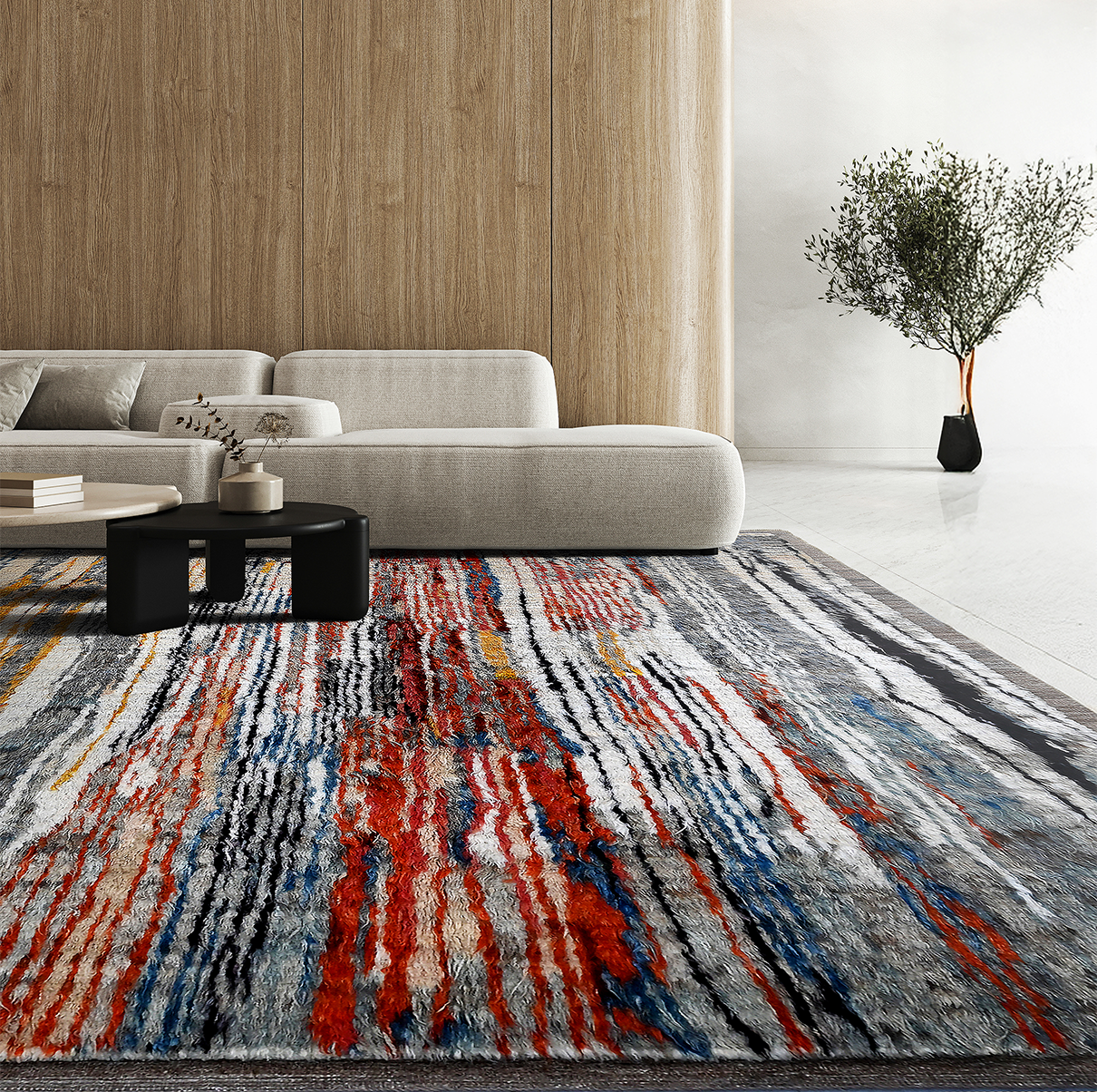
- Living room: a large wine-red Taimany under the sofa completely transforms the room. It works best with light walls (white, light grey) and natural-wood furniture.
- Bedroom: at the foot of the bed, a 200×250 cm Taimany creates a warm, enveloping effect. The wool quality is pleasant even barefoot.
- Study: a Taimany in a study or library lends a sense of history and cultural richness.
Taimany rugs at CarpetLiving
CarpetLiving has the widest selection of Taimany rugs available online in Italy — over 300 models in various formats, selected directly from Afghanistan. Every piece is photographed in detail with a description of its provenance, approximate year of production and wool specifications. For those interested in other Afghan rugs, see also the Afghan kilim.

Taimany rugs, in summary
- Origin: the Taimany (Taimuri) tribe of western Afghanistan — a centuries-old textile tradition
- Pattern: geometric grid gul on the field; linear border
- Colours: wine red (natural madder), indigo blue, beige/camel, black
- Material: hand-spun wool, dyed with natural dyes — excellent durability
- Knotting: Turkish (Ghiordes) knot for maximum stability
- Ideal for: living room (protagonist), bedroom, study


Share:
Geometric Rugs, Styles, Origins and How to Match Them in a Modern Home
How to Match Your Rug to the Floor Colour, a Practical Guide