

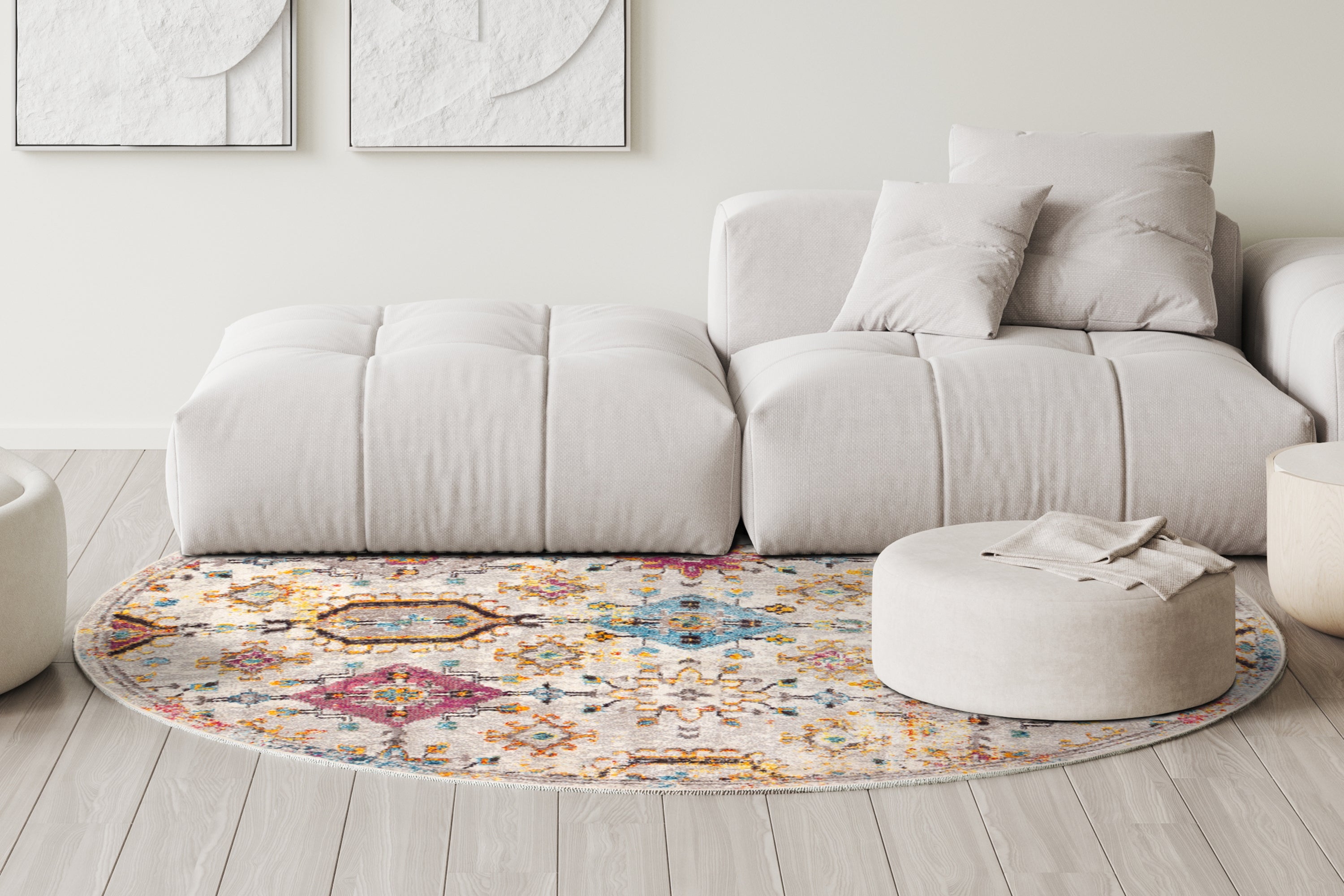
There's a moment, when you enter a well-furnished home, when you can't quite put your finger on what makes it feel right... but you feel it. Everything is softer, more harmonious, more "finished." And often, it's not thanks to the sofa or the new kitchen; it's thanks to a detail that gives rhythm to the space.
A well-chosen round rug does just that: it breaks up rigidity, softens corners, and creates a visual pause. It seems like a simple object, but in reality, it's a directorial touch. And like any directorial touch, it can be very successful or an immediate "no."
Because round rugs have one flaw: they don't forgive proportions. If it's too small, it's not "charming"; it's a coaster effect. If it's placed in the wrong spot, it's not "original"; it's confusing.
The good news? With a few rules (and a bit of honesty about how you live in your home), you can make it work naturally.
The basic principle: the round rug must be believable
A round rug shouldn't decorate the floor like a sticker. It should create an area.
This means one concrete thing: it must be large enough to "hold together" at least one important element in the room.
Imagine a reading nook: an armchair, a lamp, a small table. If the rug is tiny and only under the table, that corner doesn't become a reading nook. It becomes an armchair with a small rug.
A round rug works when it makes you think: "Of course, that's exactly where it was meant to be."

Round rug. Where does it really look good?
1) Under a round table: the most natural pairing
This is where the round rug seems "born" to be. It's pure geometry: the shape repeats, and the room gains order.
But be careful: under the table, the size is not dictated by the table. It's dictated by the chairs.
If, when you pull your chair back, half of it is off the rug, the same thing always happens:
-
chair legs get caught
-
the edge wears out and curls up
-
every movement becomes noisier and more uncomfortable
Practical, commonly used guidelines:
-
100–110 cm table → 200 cm rug
-
120 cm table → 240 cm rug
-
130–140 cm table → 250–300 cm rug
If these sizes seem "exaggerated," it's because we're used to seeing rugs that are too small under tables. And yes: they seem "okay" until you actually live with them.
2) In the entryway: the round rug that immediately says "well-kept home"
The entryway is often the most overlooked space: you throw in a console, a mirror, a coat rack, and that's it.
A round rug here works because it changes the rhythm: it welcomes you, makes you slow down for half a second. It's like a visual "welcome."
But it shouldn't get in the way:
-
if you have doors that open into the entryway, avoid high piles
-
if the space is very narrow, choose a round rug that fills it without extending under doors or into passageways
A round rug in the entryway is a choice that communicates taste without shouting. But it must be stable and practical: if it slips, the "magazine-worthy" effect lasts only until the first turn.
3) In the living room: when it works and when it doesn't
In the living room, a round rug is a great move when you want to:
-
soften a too-linear environment
-
create a focal point (coffee table, conversation area)
-
break up a living room made of rectangles (sofa, TV cabinet, window)
A round rug often works very well under a coffee table and in front of a sofa, especially if it can include at least the front legs of the sofa or an armchair.
When does it become difficult, though?
When you place it in the middle of an already "full" living room and don't give it space to breathe. A round rug needs to be seen: if you cut it off with a thousand pieces of furniture, it loses its meaning.
4) Reading nook: the most "magazine-worthy" use (because it's a scene)
This is the classic case where a round rug is perfect: it creates a micro-room within the room.
The ideal scene:
-
comfortable armchair
-
floor lamp
-
small side table
-
round rug that naturally encompasses everything
Here, you're not just "placing a rug." You're building a corner that makes you want to sit down.

5) In the bedroom: a soft touch, but with discernment
In the bedroom, a round rug is beautiful in two situations:
-
on either side of the bed, as a "soft spot" when you step out
-
in a vanity/armchair/mirror corner
Under the entire bed, it's more complex: you either choose a huge round rug (demanding, and often unnecessary) or risk a cut-off effect, which detracts from the shape's meaning.
How to choose the size
Three simple and often decisive rules:
-
If it needs to define an area, it must be large.
A small round rug rarely defines anything: it merely "decorates." -
If it's in a high-traffic area, avoid placing the edges where people walk.
Edges in the middle of a walkway are a recipe for wear and curling. -
If you're torn between two sizes, the larger one almost always wins.
A small round rug looks like a compromise. A large one looks designed.
Colors and patterns: how to avoid it looking like a "strange piece"
A round rug attracts the eye. So either make it discreet, or make it a consistent focal point.
-
If you want an elegant and easy result: neutrals, soft textures, non-aggressive patterns.
-
If you want to make a statement: choose a bolder pattern, but avoid creating a "noisy" room with too many competing elements.
A round rug should bring balance. If it adds confusion, it's not doing its job.

FAQ
What size should a round rug under a table be?
It must include chairs and the table, even when the chairs are pulled back. Often, 200–240 cm is the realistic minimum.
Round rug in the living room: where to place it?
Under the coffee table, in a reading nook, or to define a conversation area. It works when it "ties together" the furnishings.
Why does a small round rug look wrong?
Because it doesn't define an area: it appears as a random accessory. The round shape requires proper proportions.


Share:
Wool rugs: real pros and cons
Rugs and Pets: Choosing Without Turning Your Home into a Battlefield