
Persian Silk Rugs: Luxury, Luster, and Everything You Need to Know
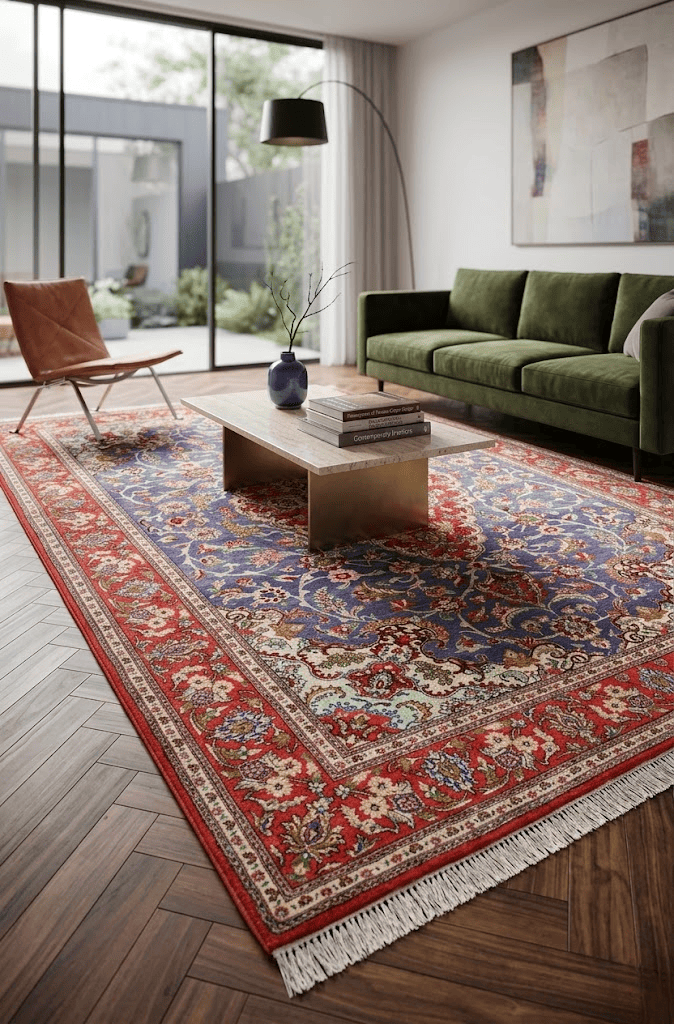
The Persian silk rug represents the pinnacle of Oriental textile art: extraordinary knot density, shimmering luster, and miniature patterns impossible to replicate with other materials. It is an aesthetic and patrimonial investment. This comprehensive guide tells you everything you need to know before purchasing.
Why are Persian silk rugs so prized?
Silk is the most resistant and finest textile fiber available in nature. In a Persian rug, this means weavers can create knot densities unthinkable with wool: ranging from 200,000 to over 1,000,000 knots per square meter in the finest productions.
The result is an extraordinary level of visual detail—flowers with single petals, human faces, complex architectures—and a shimmering luster that changes with the angle of light, a unique characteristic of silk and impossible to imitate with viscose.

Which Persian cities produce the best silk rugs?
Not all Iranian textile cities work with silk. The major silk manufacturers are concentrated in a few areas of excellence:
- Qum (Qom): The absolute capital of Persian silk. Qum pure silk rugs are considered the most refined in the world, with densities up to 800,000 knots/sqm and floral, architectural, and figurative patterns of extreme complexity.
- Isfahan: Produces high-quality mixed silk-wool and pure silk rugs, with more symmetrical compositions than Qum.
- Kashan: Excellent for silk, with classic floral patterns and a richer palette of reds and blues.
- Tabriz: Uses silk primarily for highlights (details) on a wool background, creating an effect of selective luster.
How to distinguish real silk from viscose?
Viscose (rayon) is often sold as "artificial silk" and can deceive the untrained eye. Here's how to distinguish them:
- Burn test: A strand of real silk, when burned, smells like burnt hair and self-extinguishes. Viscose smells like burning paper and continues to burn.
- Luster test: Rotate the rug: silk changes color with the angle (shimmering effect). Viscose has a flatter, more uniform luster.
- Touch test: Silk is stiffer and more resilient. Viscose deforms and crushes more easily.
- Price: An authentic QUM silk rug measuring 80x120 cm typically costs €1,500 and up. A much lower price is often a red flag.

How to use a silk rug in decoration?
Silk is a delicate material: it scratches, crushes under weight, and is sensitive to humidity. The best applications in the home are:
- Bedroom: on either side of the bed or as an accent rug in a low-traffic area
- Study/library: where foot traffic is limited and visual detail can be appreciated
- Dining room: under the table, where chair movements are the only wear
- Wall display: for the most precious pieces, wall display is the ideal solution to preserve the rug over time
Avoid: entrances, high-traffic corridors, bathrooms, or any area with frequent risk of humidity.
How to clean a silk rug?
Cleaning silk requires utmost care:
- Vacuum very gently, without motorized rollers
- For stains: blot immediately without rubbing, with a dry white cloth
- Absolutely avoid hot water, alkaline products, and vigorous rubbing
- Washing should only be entrusted to professionals specializing in Oriental silk rugs
Discover the CarpetLiving silk rug collection and Persian rugs: each piece comes with a certificate of authenticity and a detailed composition sheet.


Share:
Nain and Isfahan Carpets: The Excellences of Persian Craftsmanship
Wool, viscose, silk, jute, cotton: a guide to rug materials