

Blue Rugs and Colourful Rugs, How to Style Them at Home
A blue, green or multicoloured rug changes a room more than a new sofa does, yet people often worry it will clash with the floor and walls. In practice a colourful rug works when it follows a few rules of proportion and takes the light into account. In this guide you will find a simple method for choosing the colour, pairings for blue, green and multicoloured rugs, a reference table and the most common mistakes.
How to choose a rug colour, the 60/30/10 rule
The 60/30/10 rule is the most practical place to start. 60% of the room is the dominant colour, usually walls and floor; 30% is the secondary colour, found in the sofa, curtains and large textiles; 10% is the accent, meaning cushions, prints and objects.
A rug can sit in two places in this scheme:
- The rug as secondary colour: if it is large, for example 200x290 cm in a 25 square metre living room, it covers a good share of the 30%. Choose a shade that works with the sofa without copying it.
- The rug as accent: if it is small, like an 80x150 cm rug in front of an armchair or in the hallway, you can go for a more saturated colour and repeat it in a cushion or a print.
Before deciding, look at the floor, the walls and the sofa, in that order. The relationship with the floor has its own rules, covered in our guide on how to match your rug to the floor colour.
Blue rugs, navy, dusty blue and light blue
Blue is the easiest bold colour to bring into a home, because it behaves almost like a neutral. But not all blue rugs are alike.
- Navy: deep and solid, it suits a living room with a light grey, beige or off white sofa. It looks great with walnut, brass and leather, and makes even a classic oriental design feel less formal.
- Dusty blue: softer and slightly grey, it is ideal for bedrooms and hallways. Pair it with antique pink, sage green, natural linen and pale oak.
- Light blue: fresh and bright, it is at its best in rooms with plenty of light, white walls and mustard or terracotta accents.
If blue has to live alongside grey, choose a rug that already contains both: the Alan 1 grey and blue modern rug, from around 145 euros, links a grey or sage sofa to a pale wall without harsh breaks.

Avoid a blue sofa in the same shade, which makes the rug disappear.
Green rugs, from sage to emerald
Green pairs naturally with wood and plants, so it settles easily into a home even with white walls.
- Sage and olive: calm, they go with beige, cream, terracotta and light wood. They are a warmer alternative to grey.
- Forest and emerald: intense, they need clean contrasts such as an ochre velvet sofa, a cognac armchair or gold metals.
- Green in kilims: in flatweave rugs green often mixes with reds, blues and beige, creating a warm base for living rooms with lots of wood.
Avoid saturated green and blue in similar amounts in the same room, as they compete, and acid green next to orange toned wooden furniture.
Multicoloured rugs in the living room, how to avoid chaos
- Start from the rug's dominant colour and use it for 30% of the room, for example in the curtains or a throw.
- Pick a minor colour from the rug as your accent and repeat it two or three times: a cushion, a vase, a print.
- Keep large pieces neutral: with a multicoloured rug the sofa should be grey, beige, white or a solid colour already present in the rug.
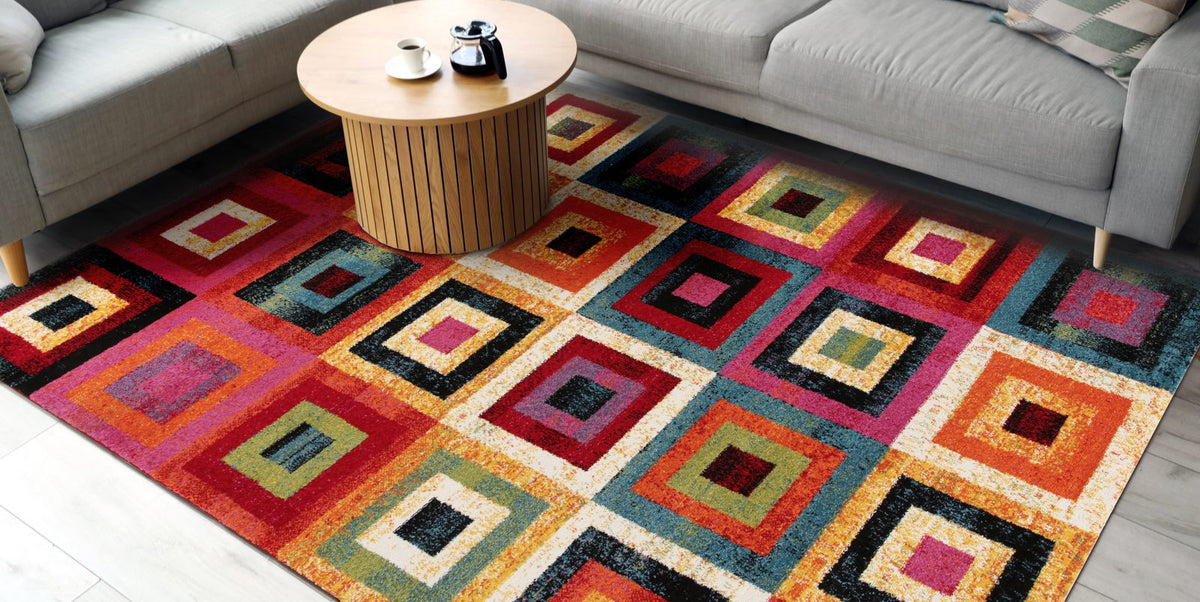
- Limit patterns: if the rug is geometric, choose plain or finely striped fabrics. For more on designs, read our guide to geometric rugs and how to pair them.
Stripes are a good compromise: colour without too much pattern, and easy to match.

Colour and light, dark rooms and bright rooms
The same rug looks different from one room to the next: observe the light at the times of day you use that room most.
- Rooms facing north or with little light: the light is cool and tends to dull blues and greys. Warm, petrol leaning blues, olive greens, terracotta, ochre or a multicoloured rug on a cream ground work better.
- Rooms facing south or very bright rooms: the light is warm and can carry fresh colours such as light blue, dusty blue and sage.
- Artificial light: warm bulbs (2700 K) warm up blue and make green look more yellow; neutral bulbs (4000 K) show a colour closer to the photos.
Rug colour, recommended pairings, what to avoid and common mistakes
| Rug colour | Recommended pairings | Avoid |
|---|---|---|
| Navy | Light grey or beige sofa, walnut, brass, leather | Blue sofa in the same shade, dark rooms with grey walls |
| Dusty blue | Antique pink, sage, linen, pale oak | Bright red, large amounts of black |
| Light blue | White walls, mustard, terracotta | Floors with a bluish cast, rooms facing north |
| Sage green | Beige, cream, light wood, plants | Dominant cool grey, which dulls it |
| Emerald green | Ochre velvet, cognac, gold, warm white | Saturated blue in equal amounts |
| Multicoloured | Neutral sofa, one rug colour repeated in accessories | Cushions and curtains with other patterns |
The most frequent mistakes with colourful rugs:
- Choosing the colour by looking only at the sofa: the rug is seen mostly against the floor, so judge the two together.
- Buying a rug that is too small: a bold colour in a small format looks like an isolated patch. In the living room the rug should reach at least under the front legs of the sofa; for sizes see our guide to the rug under the sofa.
- Matching everything to one shade: two or three tones of the same colour work better.
- Forgetting maintenance: very light colours show dirt, very dark ones show dust and hair. Mid tones and busy designs are more forgiving.
Blue and colourful rugs at CarpetLiving
In our modern rugs collection you will find plain colours, geometric and abstract designs in blue, green and multicolour. If you are looking for a centrepiece for the living room, browse our designer rugs for the living room; for a more textured colour, our kilim rugs combine green, blue and red in a flatweave. Three examples to start from:
- Classic blue: the Farshian Hereke 2 Navy, an oriental design on a navy ground, from around 21 euros.
- Green wool: the Kilim Tonum Green with a patchwork effect, from around 121 euros.
- Geometric multicolour: the Gioia A rug, from around 29 euros.
Blue and colourful rugs, summary
- Use the 60/30/10 rule: a large rug is a secondary colour, a small one can act as the accent.
- Navy behaves almost like a neutral; dusty blue and light blue need bright rooms and soft tones.
- Green works with wood and plants: sage for calm spaces, emerald for bold contrasts.
- With a multicoloured rug, keep large pieces neutral and repeat one of its colours in your accessories.
- Judge the colour in the real light of the room, by day and in the evening.
Share:
Kilim rugs in the living room, 10 pairings that work