
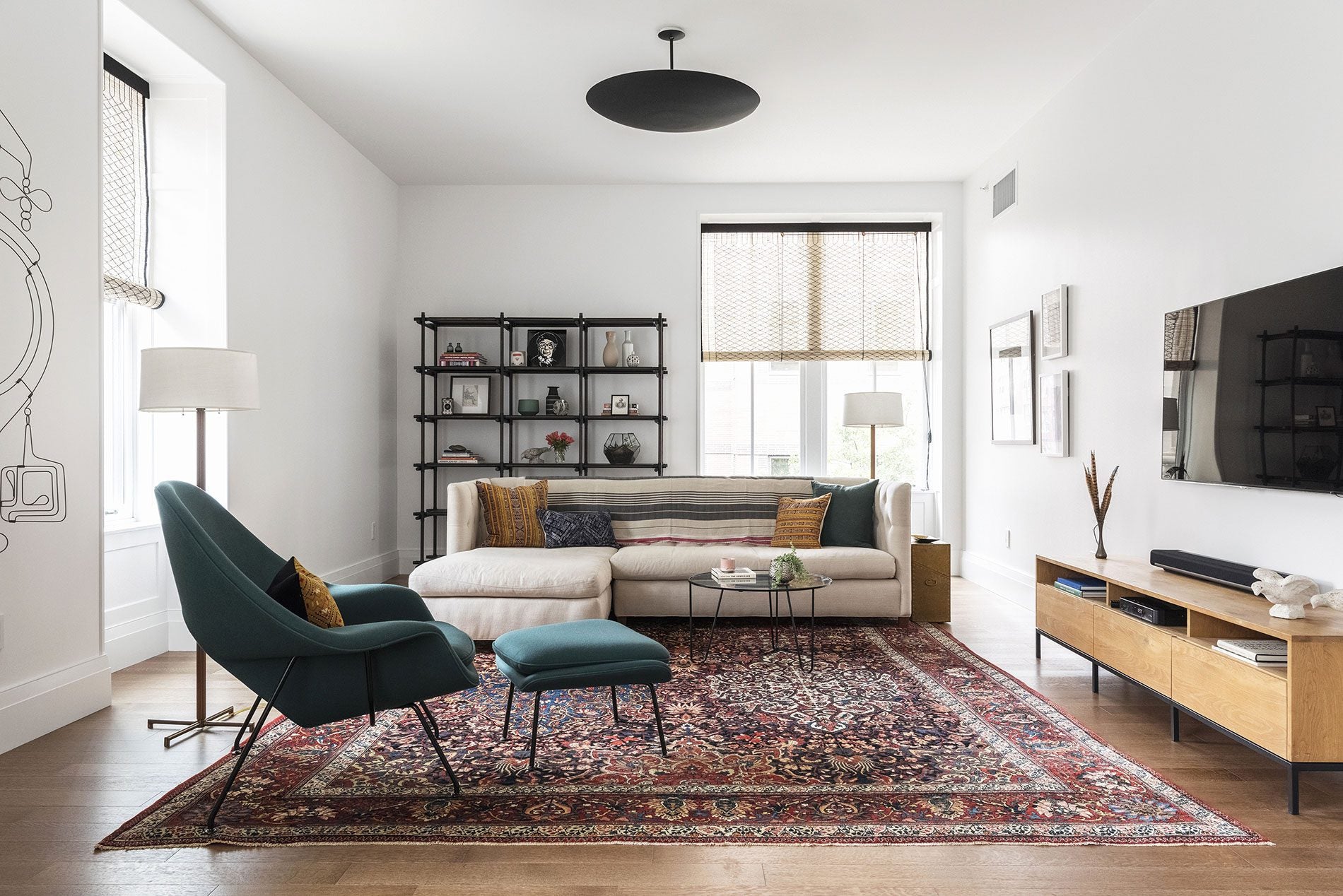
Nain and Isfahan carpets, the excellence of Persian craftsmanship
If oriental carpets were a hierarchy, Nain and Isfahan would be at the top. For centuries, these two Iranian cities have produced some of the most esteemed Persian carpets in the world, with exceptional knot density, sophisticated palettes, and floral patterns of absolute refinement. Discover what distinguishes them.
What is a Nain carpet and what are its characteristics?
The city of Nain, in the province of Isfahan, developed its textile tradition in the twentieth century, quickly becoming synonymous with excellence. Nain carpets are recognizable by:
- Cool and refined palette: ivory and cream dominate the field, with borders and medallions in cobalt blue or navy blue and accents in beige, brick red, and subtle gold
- Very high density: the most prized Nains (6la or 4la, where "la" indicates the threads per knot) reach 500,000–800,000 knots per square meter
- Use of silk in highlights: many Nains use silk for finer floral details, creating a luminous effect on the wool background
- Classic floral pattern: arabesques, flower vases, central medallion and pendants, multiple border with Greek key patterns

What is an Isfahan carpet and how does it differ from a Nain?
Isfahan is the great historical capital of Persian textile art, with a tradition dating back to the 16th century and the Safavid period. Isfahan carpets are distinguished by:
- Richer palette: deep Persian reds, royal blues, emerald greens on ivory or midnight blue fields — more chromatic than Nain
- More elaborate design: Isfahan cartoons (patterns) are among the most complex in the Persian tradition, with perfectly symmetrical compositions
- Kork wool: the best Isfahan wool is "kork," the first spring shearing, extraordinarily soft and with a natural luster
- Typically large format: large representative Isfahan carpets (3×4 m or more) are museum pieces and investments
How to recognize the quality of a Nain or Isfahan carpet?
Five quality indicators you can check in person:
- Knot density: fold the carpet and count the knots per 10 cm. Over 50 knots per 10 cm in both directions is a good indicator.
- Pile uniformity: run your hand against the pile: the surface should be uniform, without tufts or sagging.
- Back of the carpet: the pattern must be legible on the reverse side as well. The greater the definition of the back, the higher the density.
- Symmetry: fold the carpet in half: the two mirror images of the pattern must match perfectly.
- Certification: excellent quality Nain and Isfahan carpets often come with certificates of origin and authenticity.

Nain or Isfahan carpet: which one to choose for your decor?
The choice mainly depends on the room's palette:
- If your decor is dominated by neutral tones, whites, grays, and naturals: the Nain with an ivory background fits perfectly without dominating the space.
- If you are looking for a strong chromatic focal point, an element that takes center stage: the red or blue Isfahan is the right choice.
- For classic and formal environments: both work, but the Isfahan has more visual and historical "weight."
- For contemporary or minimal environments: the Nain on a light background adapts better; its pattern feels more "airy."
How much does an authentic Nain or Isfahan carpet cost?
Prices vary enormously based on format, density, age, and origin. As a rough guide:
- Nain 6la, 160×240 cm, contemporary manufacture: from €1,200 to €2,500
- Nain 4la (finer), same format: from €2,500 to €5,000
- Isfahan kork, 200×300 cm, fine manufacture: from €3,000 to €8,000
- Valuable antique or semi-antique Isfahan: prices have no ceiling
Explore the Nain collection and Isfahan Persian carpets on CarpetLiving: a curated selection with complete technical specifications.


Share:
The carpet as an investment, when an antique carpet is worth more than a work of art
Persian silk rugs: luxury, luster, and everything you need to know