

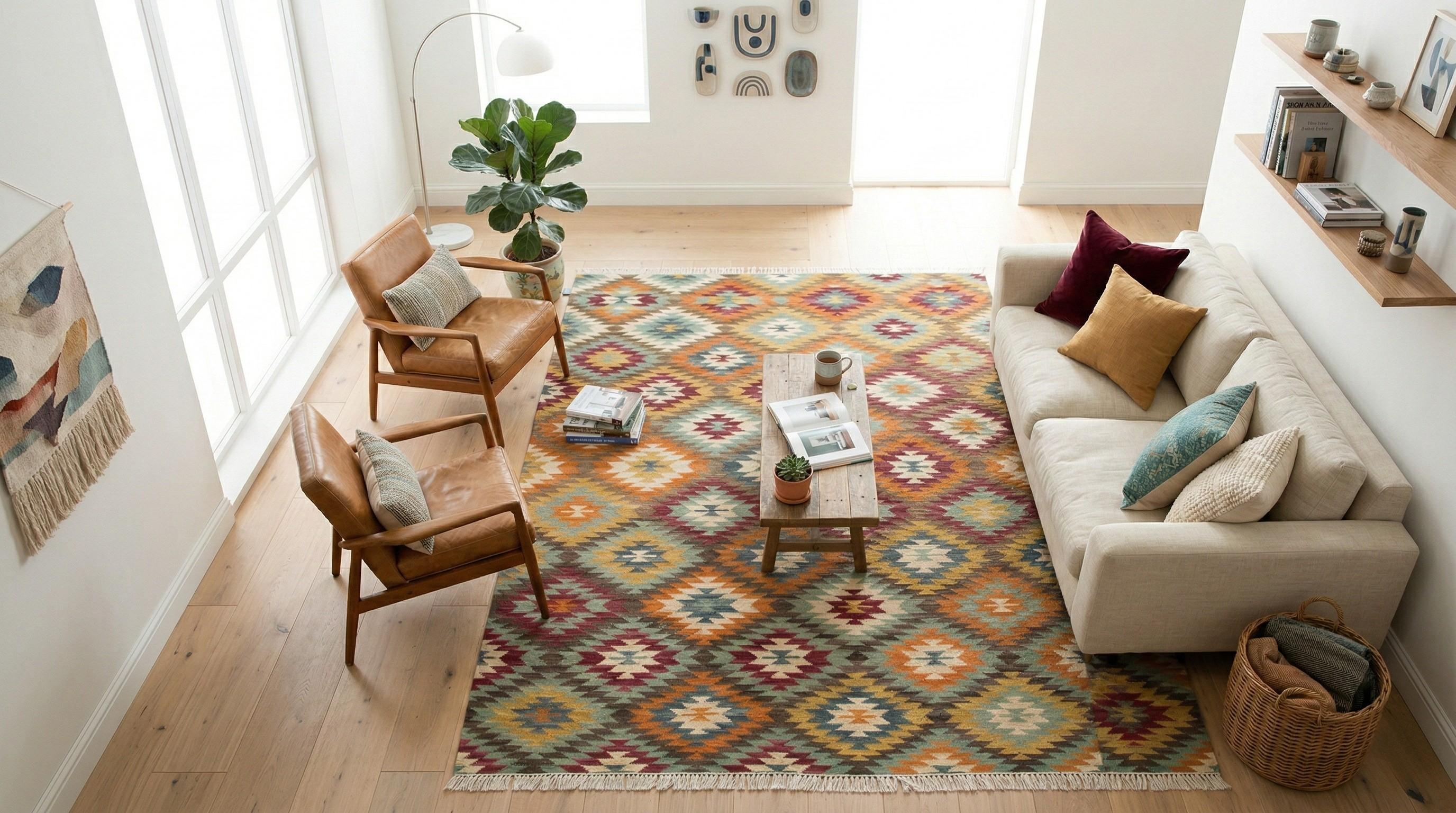
A kilim is much more than a rug. It is an object that tells a story: who wove it, where, with what wool, with what design. It is born in the hands of nomadic weavers who crossed the Anatolian plateau or the plains of Afghanistan, and over time it has become one of the most sought-after elements of contemporary furnishing. Colorful or neutral, traditional or designer, small or large: in this guide, you will find everything you need to know about kilims to choose wisely.

What is a kilim?
A kilim is a flat-woven rug, meaning it has no pile. The technique consists of interlacing warp and weft without adding knots that create vertical thickness — unlike knotted oriental rugs such as Persian or classic Afghan rugs. The result is a flat, lightweight, flexible rug with the design visible on both sides.
This structure makes it unique: it doesn't have a fixed "top" and "bottom," it has a thin, almost textile texture, it withstands daily traffic well, and it can also be used as a vertical decorative element — hung on a wall like a painting, it encapsulates years of artisanal history in a single artifact.
In summary: a kilim is a flat-woven, pileless, lightweight rug with geometric patterns and deep artisanal origins. It is the meeting point between nomadic tradition and contemporary design.
Origins and history of kilims: Afghanistan, Turkey, Iran, and India
The word "kilim" comes from Turkish and has spread as a collective term to refer to all flat-woven rugs produced in the area stretching from Anatolia to Central Asia, including Iran, Afghanistan, and the Indian subcontinent. Its origins are ancient: flat-weaving artifacts date back to the 5th–6th century BC, but the techniques were already in use in nomadic societies much earlier.
Each region has developed a recognizable style:
- Turkish kilims (Anatolia): the best known to the Western public. Characterized by symmetrical geometries, warm colors — brick red, deep blue, ivory, mustard — and a centuries-old textile tradition. The most prized productions come from Konya, Sivas, Koceaber, and the Aegean area. The Sivas Kilim is among the bestsellers in our collection: each piece is unique.
- Afghan kilims (Kaudani, Baluchi, Ersari): produced in the northern provinces of Afghanistan, such as Faryab and Kunduz. Hand-spun raw wool, intense colors, asymmetrical tribal geometries. The Kaudani Kilim, woven by the tribes of northern Afghanistan, uses local wool with natural dyes. Each piece is authentic and unrepeatable.
- Iranian kilims (Qashqai, Fars): more refined, with a nuanced palette, stylized floral motifs alongside geometric ones. Very fine technique, often with premium quality wool.
- Indian kilims: predominantly produced in Rajasthan and Uttar Pradesh. Contemporary designs or tradition-inspired, mixed materials, more accessible prices.

How to distinguish an Afghan kilim from a Turkish one?
This is one of the most frequent questions for those approaching the world of kilims. Here are the main distinguishing features:
- Wool: Afghan kilims use raw local wool, often hand-spun, with an irregular and rustic texture. Turkish kilims use more uniform wool, shorn from Anatolian sheep.
- Colors: Afghan kilims tend towards dark and intense palettes — burgundy, ochre, black, midnight blue. Turkish kilims have a more varied palette: vibrant reds, cobalt blues, ivory, sage green.
- Geometries: both use geometric patterns, but Afghan kilims are often irregular and asymmetrical (each piece is unique). Turkish kilims tend to have more regular symmetry and repeating motifs.
- Sizes: authentic Afghan kilims have variable dimensions because they originate from the loom of individual weavers. Turkish kilims can be either unique pieces or produced in standard commercial sizes.

Traditional and modern kilims: how to choose
Traditional kilims have direct artisanal roots: hand-woven with natural wool, patterns passed down through generations, often unique pieces. Perfect for those seeking authenticity, strong visual character, and a story behind the object.
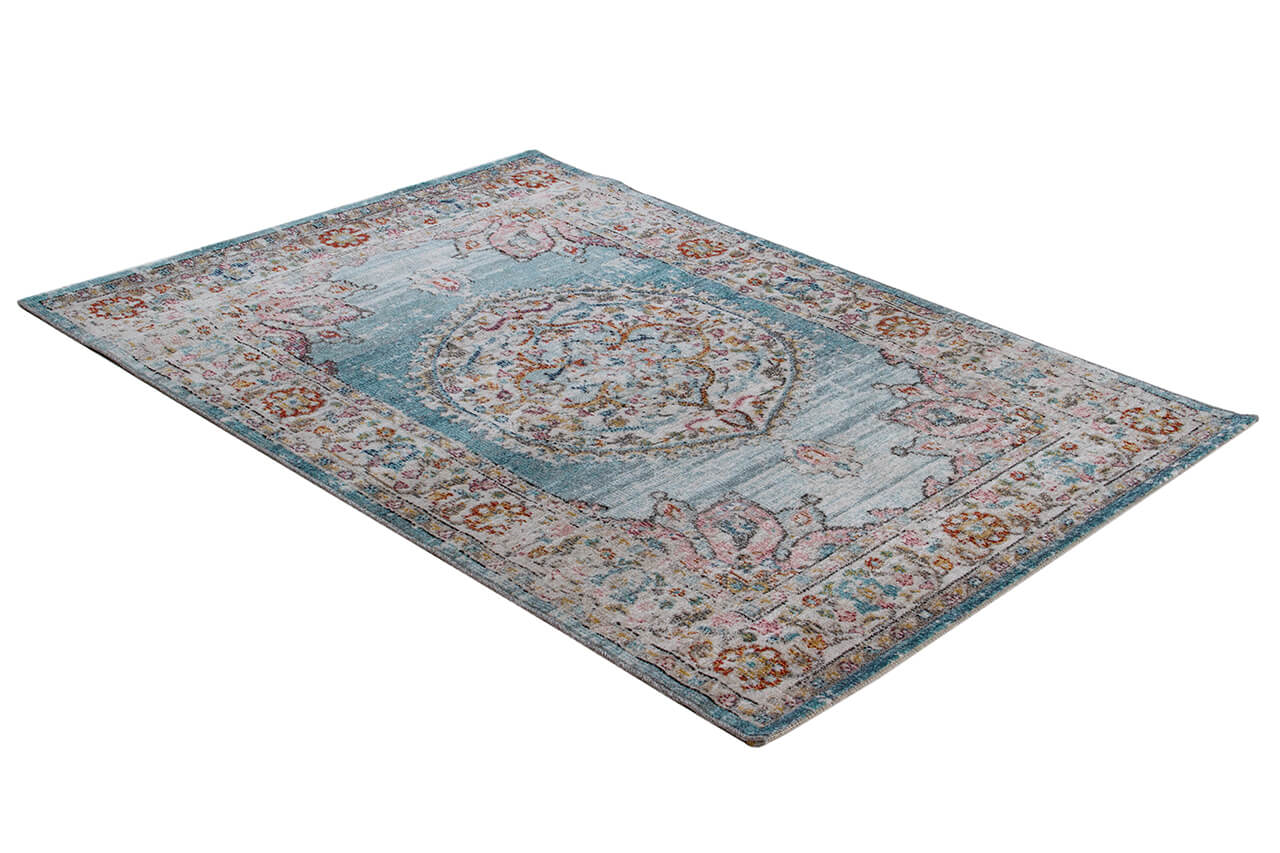
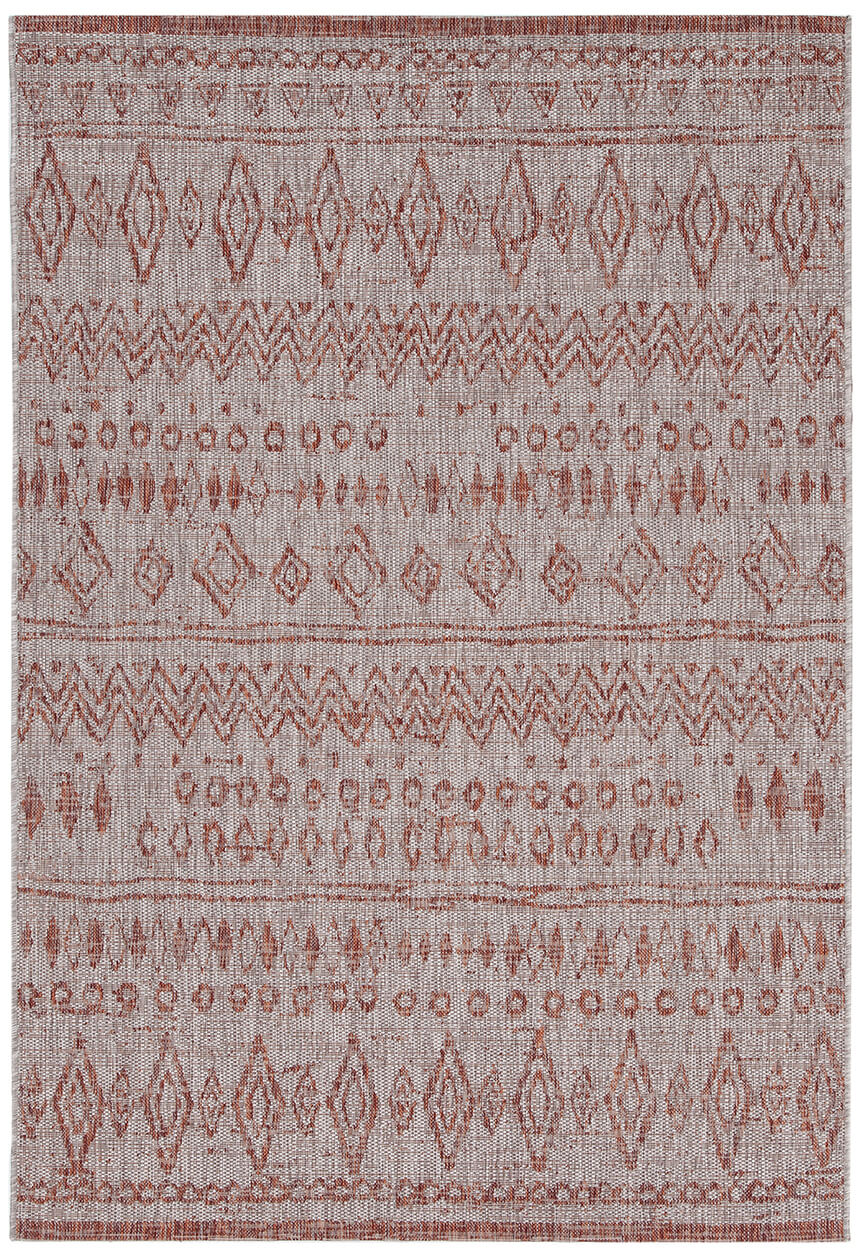
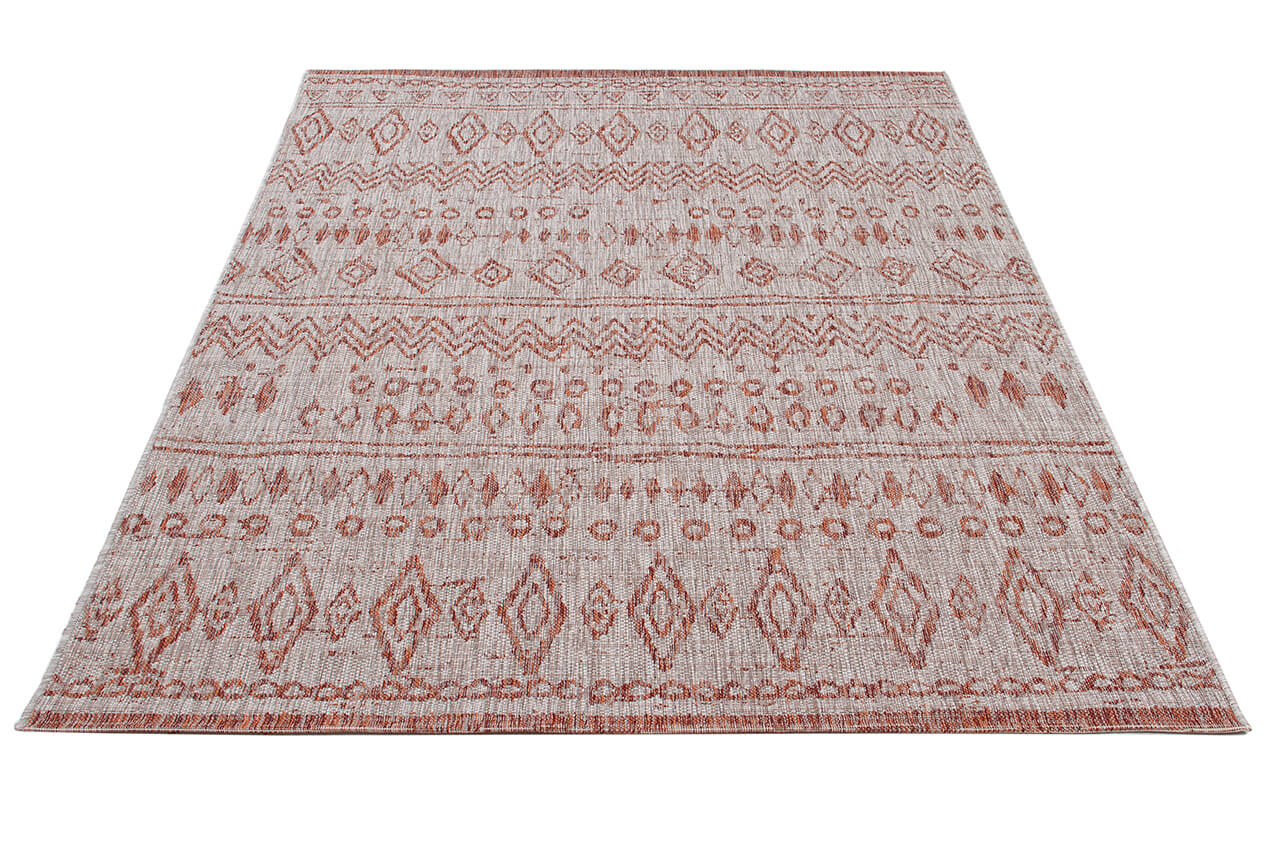
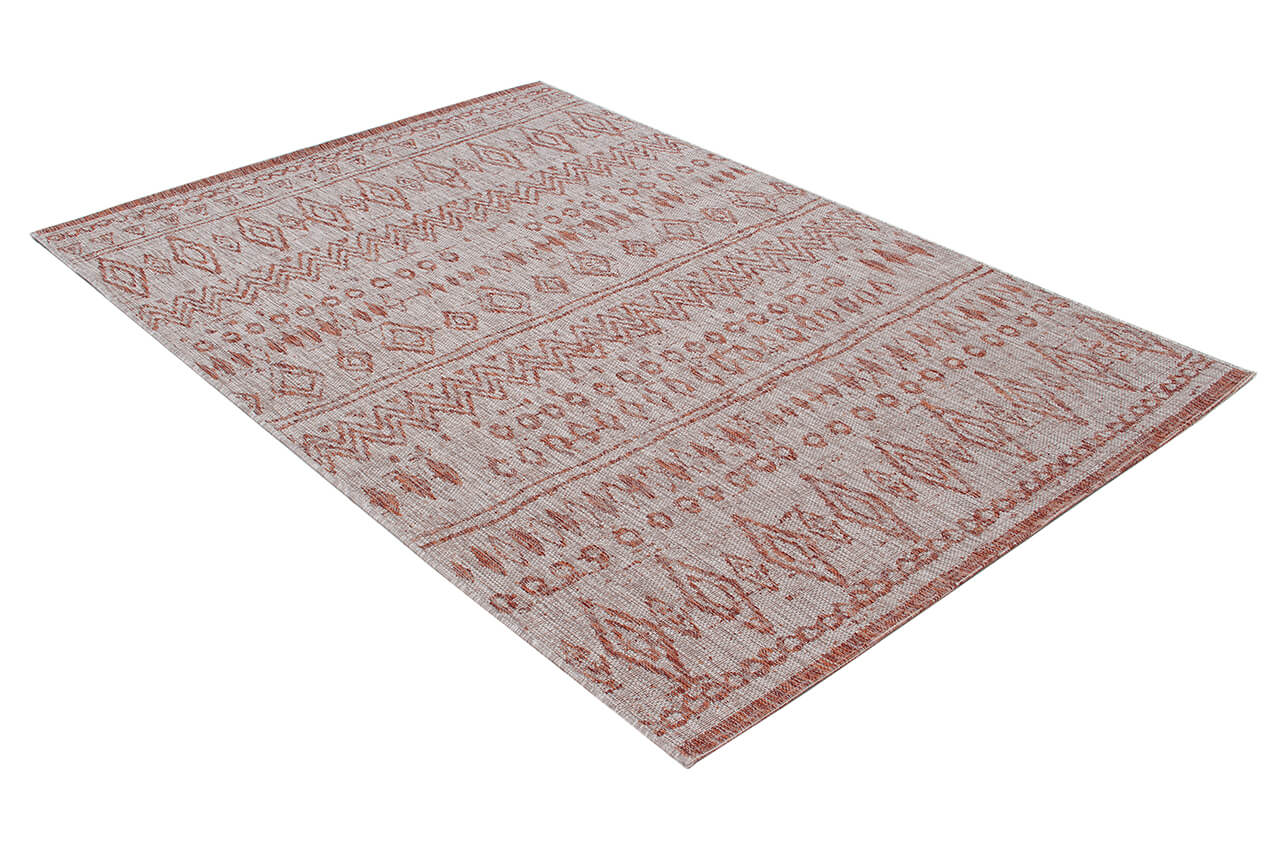
Modern kilims adopt the flat-woven technique but reinterpret patterns in a contemporary key: cleaner geometries, neutralized palettes (beige, gray, off-white, terracotta), designs conceived for minimalist or Nordic interiors. Materials like viscose, cotton, or wool blends allow for more uniform colors and accessible prices.
There's no better or worse; it depends on your decor and the effect you want to achieve. If you have neutral interiors and want a characterful element, a traditional kilim makes the room. If you're looking for a kilim that integrates without dominating, a modern designer kilim is the right choice.
Kilim materials: wool, cotton, and mixed fibers
- Wool: the quintessential historical material. Regulates temperature, absorbs sound, and develops a unique patina over the years. Wool kilims have a slightly irregular texture that makes them authentic.
- Cotton: lighter and more uniform. Used as a basic warp or as the main fabric in modern kilims. Easy to clean, vivid and stable colors.
- Jute and natural fiber: some contemporary kilims use jute or organic cotton. Rough and natural texture, perfect for rustic or boho environments.
- Mixed (wool + cotton or viscose): combine materials for particular visual effects, with a more accessible price compared to pure wool.
Practical rule: for high-traffic areas (entrance, hallway, kitchen), choose robust wool or cotton. For the bedroom or relaxation area, viscose and mixed fibers also work very well.
How to style a kilim at home
- Living room: under the coffee table in front of the sofa or in the reading area. A colorful kilim on light parquet or concrete creates instant contrast and warmth.
- Bedroom: at the foot of the bed or to the side. Brings intimacy and texture without overwhelming the space.
- Entrance and hallway: ideal in runner format. Withstands traffic well and provides a welcoming touch with color and craftsmanship.
- As wall decor: a large kilim hung on the wall becomes a textile artwork. Perfect in living rooms with white walls or in an industrial style.
Color matching: with neutral interiors, a colorful kilim always works. For already characterized environments, opt for a kilim in a reduced palette — ivory and terracotta, or black and white.

Size guide: what kilim size to choose?
| Room | Recommended size | Notes |
|---|---|---|
| Living room (under sofa) | 230x160 cm or 300x200 cm | At least the front legs of the sofa should be on the rug |
| Double bedroom | 200x140 cm (foot of bed) or 300x200 cm | The 300x200 cm covers the three sides of the bed |
| Entrance / hallway | 150x80 – 250x90 cm runner | Afghan kilim runners: variable sizes, unique pieces |
| Dining area | Table + 60 cm per side | With a 180 cm table → minimum rug 300x200 cm |
| Children's room / reading area | 160x100 cm or 200x140 cm | The flat kilim is safe: no obstacle to trip over |
How to clean and maintain a kilim
Kilims are easy to maintain precisely because they have no pile. Vacuuming at low power (without a rotating brush) or shaking them outside is sufficient for routine cleaning. In case of stains, blot immediately with a damp cloth and neutral detergent — without rubbing. Wool or cotton kilims can be hand-washed or entrusted to a specialized laundry.
Why choose a kilim from CarpetLiving
CarpetLiving selects its kilims with a catalog that includes over 400 models: from hand-woven Turkish Sivas Kilims to authentic Afghan Kaudani, and modern designer kilims in viscose and cotton. Each product is photographed, described with real measurements, and available with free shipping above a certain threshold.
→ Browse the entire kilim collection
Everything you need to know about kilims: summary
- A kilim is a flat-woven, pileless, lightweight, and reversible rug.
- It originates from the Anatolia–Afghanistan–Iran–India area, with different styles for each territory.
- Afghan kilims are more rustic and irregular; Turkish kilims are more symmetrical and colorful.
- The main material is wool, followed by cotton and mixed fibers for modern ones.
- Works well in the living room, bedroom, entrance — and hung on the wall as a textile artwork.
- Most common sizes: 230x160 and 300x200 for the living area; 150x80 runner for hallways.
- Easy to maintain: no pile, no deep dust accumulation.


Share:
Rugs for Airbnb: The choice that increases bookings
Rugs for Hotels, B&Bs, and Accommodation: The Contract Guide